
Course Content
-
0 / 12
PHOTONIC MEDICINE - MODULE 2
-
PHOTONIC MEDICINE Day 1 video 1. Slides 9, 3 and 2
-
PHOTONIC MEDICINE Day 1 , video 2. Slide 1, 4, 5 and 6
-
PHOTONIC MEDICINE Day 2 , video 1. Slide 10
-
PHOTONIC MEDICINE Day 2 , video 2. Slide 7, 8,
-
PHOTONIC MEDICINE Day 3 , video 1. Slide 13, Guidelines and 15
-
PHOTONIC MEDICINE Day 3 , video 2. Slide 14, 17, 20, 19, 21 and 12
-
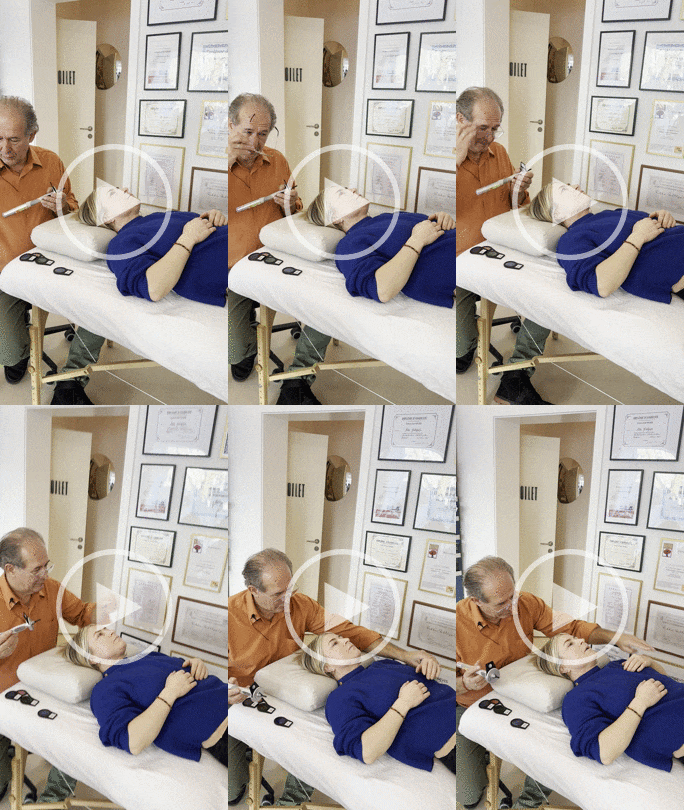
PHOTONIC MEDICINE Day 3 , video 3 Anne Kathrine - Sinus treatment
-
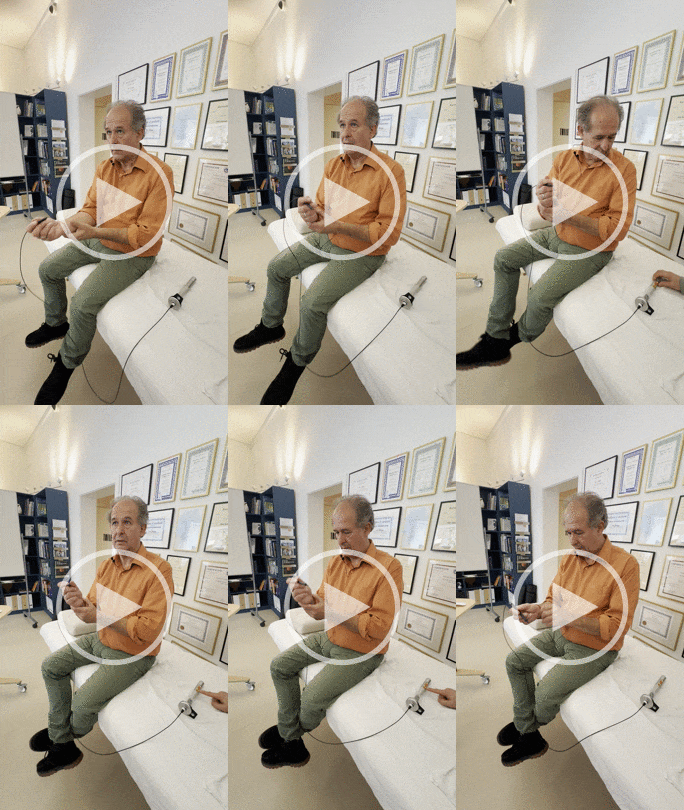
PHOTONIC MEDICINE Day 3 , video 4 Self Care
-
PHOTONIC MEDICINE Video respir
-
PDF Slides

-
Informative links

-
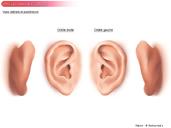
Ear drawing
-
-
0 / 4
Q&A - Module 2
-
0 / 2
Case presentation - Module 2


Cases presentation june 2026
4:15:10
6 comments
QUESTIONS for LYN:
Jay: Q for Lyn: During the second session with your client you were not able to classify the type of tinnitus. Did you attempt to classify the tinnitus in subsequent sessions and how, if at all, would you have altered the colour sequencing based on a particular classification?
Hanne: Q for Lyn: The tinnitus is obviously related to this second significant head trauma. I am thinking, as there were no significant improvements with the first 4 sessions, do you think there could be an unresolved physical condition, maybe scar tissue in the left occipital lobe, linked to the condition that you are treating, or neck injury with the vagus nerve and trigeminal affliction? (I am asking this, as I had a previous case very similar to this one)
Jon: Very brave of you to take on tinnitus for your first case! Thank you I’m very excited to learn more about treating this.
Q: did those chosen points from the dr magnin protocol, give it a very prominent VAS IN THE INITIAL GREEN 53 EXPLORATION?
i’m curious if any other strong VAS areas you were considering… especially the CNS areas of the year (auditory processing centers?)
Eva: Hello Lyn: Here is my question to your presentation on Saturday. Always interesting to hear about tinnitus treatment, it can be challenging. I really like you being so observant in noticing details. I was wondering , even though the tinnitus is still almost the same, if there are other things in your client’s body and wellbeing reacting to the treatment, indicating a started process? Especially after the strong VAS appeared? Maybe the sound in his ears is not the first thing changing in the process.
Rikke: I have a question for both Lyn and Pascal.
Lyn, considering that the tinnitus followed a significant head trauma and that another traumatic memory emerged during treatment, do you think there could be an unresolved emotional component linked to the condition?
Pascal, if the tinnitus is maintained by a limbic or emotional imprint rather than only by a physical lesion, how would you approach its treatment with Photonic Medicine?
QUESTIONS for MEIR:
Jay: For Case 2, second treatment session why did you use C Frequency with the colours here and not previously?
Hanne:
Case 1.: Really nice reflections and solving of the case. Y12 did what it's meant to do😊 Thanks for proving it.
Could filter Y15 be tested and used first to remove any inflammation?
Case 2.: Nice testing in the search for the right filters and seeing improvement, and I think we all would like to do stuff for our clients additionally 😊 Did you consider testing Y12 also for this nerve damage issue?
Jon:
anaesthesia case
Excellent to see such a great and quick response to the treatment!
Q: I’m wondering if you checked green 58 for VAS? It definitely comes to mind for cleanup/lymphatic drainage of the site
Eva: Hello Meir, this is my question to your presentation on Saturday. I really love your way of so elementary choosing colors, and all your good considerations along, that we get to follow. Also really creative thinking in case one. I almost can’t think of anything to ask, except for your decision of not using frequencies on the ear. Is that your normal choice, or is it to be more gentle on the newly operated clients?
Lyn: Thank you for your two cases. They're printed out and in the binder as a valuable future reference source for me. Meir, I’m probably the only member of the cohort who has no background in acupuncture or auriculotherapy, so I have a headful of very basic questions that everybody else knows. I was intrigued by your reference to Phase 3 and its purpose being prevention of deeper pathological penetration. If you could elaborate on that it would be instructive for me, although the others might might it unnecessary.
Rikke: I have a question regarding Case 1.
Could you explain how you selected Yellow 12 as your primary treatment colour? Did you identify it through VAS testing and colour signatures on the patient's body and lesion site, or on the auricular projection corresponding to the lesion, or was it mainly a theoretical choice based on the Photonic Medicine teaching material?
QUESTIONS for EVA:
Jay: In any of your 4 assessments was there any finding of emotional issues?
Hanne: Did you think there may be an unresolved emotional component linked to the condition affecting the diaphragm function, as you are aware of and do treat? This could be, blocking the energy from going down and causing vomiting, as well as the other symptoms, disregarding the bladder symptoms.
Jon: I think you can have various points on the ear with a lot more VAS then found at the entry point. Is that why you think you are assessing the entry point incorrectly??
Excellent case and very inspiring!! I love how you treated the diaphragm!
Q: I’m curious why you decided to treat both ears for the digestive organs?
Rikke: I have a question for both Eva and Pascal.
Eva, you mention that the patient had suffered from bladder and urethral irritation since a young age, and later you found VAS in the bladder area. Do you think the reflux and bladder symptoms could be manifestations of the same underlying dysfunction of the mucous membranes rather than two separate conditions?
Pascal, in Photonic Medicine, would you consider this a generalized mucosal inflammatory pattern, and if so, would it influence your treatment strategy?
QUESTIONS for HANNE:
Jay: During Treatment 3 the last procedure you performed was:
“Last: the following acupuncture points were applied with filter 98 for 10 sec each;CO4, LE3 bilat., MP6 and LE14 right”.
Could explain why you chose these points with I-98 and what they represent?
Jon: Good job for taking on such a complex case.
Q: for you and Pascal… for the point at the inferior end of the right ear lobe during treatment 1, did you have a hard time deciding if it was an emotional scar point or a projection of a part of the brain, such as one of the cortices? Since both are plausible in this case, any suggestions on how to verify? The answer could be an emotional scar is a projection of a part of the brain. Would you need to determine this so you could treat in situ on the brain to treat the scar effectively?
Eva: It seems like your patient really got in contact with a lot during your treatments of trauma, and that VAS went down. I am curious if you also ended up making the patient think of good and safe situations, and which color you would use here, maybe 47? – this could also be a question for Pascal to answer? And this is extra: how long did the treatment of traumas take? I am thinking, could it be a whole session, including breathing exercise/diaphragm work?
Lyn: Hanne, I am in awe of your case study - so detailed, so thoughtful, so well-structured, so very professional. It’s printed out, in the binder, and will serve to inform me going forward. Rikke’s chicken and egg question regarding whether the emotional preceded the physical or vice versa in producing an amelioration of symptoms is pertinent. My sense is that your experience led you to address the emotional as a priority. Is this so, and if yes, what were the signals from the client that tipped you in that direction?
Rikke: As the treatment progressed, emotional memories and physical symptoms seemed to evolve together. Looking back, do you think the patient's physical symptoms were primarily a manifestation of unresolved emotional trauma, or do you see the emotional release as a consequence of restoring physiological balance with Photonic Medicine?
QUESTIONS for RIKKE:
Jay: It seems your client did not report any significant mobility or immune system issues, which I thought was curious! Was there any indication, during the assessment, of such issues and, if so, how would you have incorporated these into your treatment priorities
Jon: Thank you for your case. I really appreciated learning more strategies to treat the nervous system.
I’m curious why you chose to leave body treatment for the fourth session? Was it for time reasons or did you perceive an advantage in focussing solely on the ear for a few sessions?
Hanne:
Q for Rikke: Treating points with the most VAS works 😊. The pelvic area seems to be very important. Do you think there could be an underlying psychological reason for this area being still active, also given that you use colours 12 and 47 in treatment?
Q for Pascal: Could Orange 21 be the first colour you would investigate with, in a patient with low dopaminergic tone (if this causes ADHD symptoms), followed by assessment of Yellow 12 and 16 on the points for regulation of autonomic and neuroendocrine functions?
Eva: Hello Rikke, here comes my Q for your presentation of your case on Saturday. It’s really interesting that you can already achieve so much by focusing on autonomic regulations. Of course the controlpoints are on the pinna, but have you also had other considerations about waiting to treat on the body: f.ex. tiredness of patient, not to confuse the body or to keep a certain structure in your mind on plan of treatment? Just asking, as I have often been wondering, if I was doing too much treatment at one time.
Lyn: “Green 53 was consistently used between each colour sequence to restore autonomic balance before continuing the investigation.” This is something I have completely failed to take on board before you included it in your report. Is this a protocol we should use in all situations, or is it a move particularly suited to cases where deregulation presents as the key concern?
QUESTIONS for JON:
Hanne: Super detailed and precise introduction to the case. It's beneficial that you used Green 53 to normalize laterality before proceeding. The client had obvious reactions to the treatment and a release of symptoms. Nice presentation of the selection, both of colours chosen and the order in which you used them.
Q; Does the patient's emotional regulation difficulty indicate a need to investigate colours affecting higher brain centres or laterality or do you think they might come from the vagus nerve affection from the neck injury?
Eva: Hello Jon, this is my question to your presentation on saturday. I really can’t wait to treat spinal problems with photonic medicine after this positive result, you have had. Very good description all the way, and with all the relevant medical history. I wonder, if you – when you are going to treat the interscapular area where the physical trauma happened – would consider searching and treating the whole spine, including the sacrum/pelvic area? As a manual therapist I think, restrictions in one place of the column affect the others, so I usually treat all the way.
Jay: Considering “that the patient experiences difficulty in emotional regulation, extremes in mood/mental states and generally struggles with mental health”, would you have considered supporting her mental/emotional states along with treating the pain from the start and how would this have altered the treatment applied and potential outcome?
Lyn: Well, Rikke keeps reminding us that we have to ask questions, so simply admiring your study is insufficient. From the depths of my ignorance I need to generate a question for you. So, you want to use the yellows, 3,9 & 12 which you don't have, with this client. Why are you motivated to work with these colours for her when you can?
Rikke: Jon, you focused your treatment mainly on the cervical spine and achieved very good results. If you were to continue treating this patient, would you keep the same strategy, or would you start exploring and treating the other significant ear points you identified?
Pascal, at what stage would you decide to move beyond the main symptomatic area and begin treating the deeper regulatory or associated points?
Leave a comment
Please log in or register to post a comment